Mental Health of Maritime Cadets in the Digital Era: An Instagram Netnographic Study in the Context of the 2026 STCW Amendment
Kesehatan Mental Taruna Maritim di Era Digital: Studi Netnografi Instagram dalam Konteks Amandemen STCW 2026
DOI:
https://doi.org/10.48192/vns.v14i1.858Keywords:
Maritime Cadets, Mental Health, Digital Social Support, Netnography, STCW AmendmentAbstract
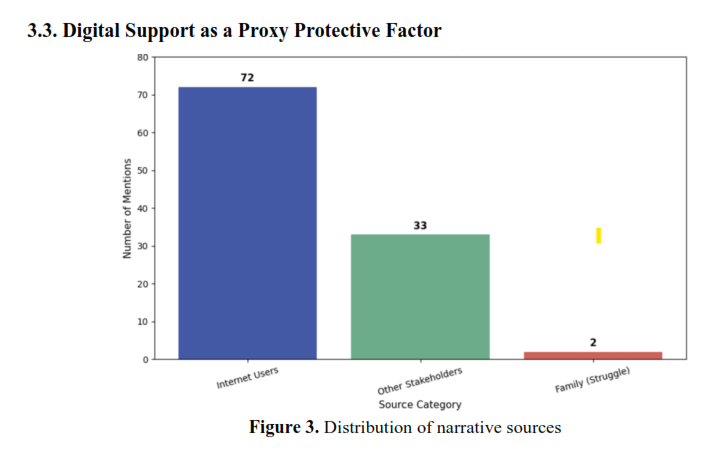
This study aims to analyse the mental health needs and patterns of psychosocial support among maritime cadets in the digital era, particularly in anticipation of the 2026 amendment to the Standards of Training, Certification and Watchkeeping (STCW). A qualitative netnographic approach was employed to analyse public Instagram content related to maritime cadets. Data were collected from 20 digital postings and processed using NVivo thematic coding analysis. The findings indicate that the dominant narrative within the digital ecosystem of maritime cadets is “appreciation and positive support,” representing 70% of all coded narratives. Notably, 68.6% of these supportive narratives originate from general internet users, suggesting that emotional validation is largely derived from public digital audiences. In contrast, narratives coded under “struggle” account for only 1.3% of total mentions, indicating possible impression management in social media environments. Digital support functions as a proxy protective factor against psychological pressure. However, the dominance of image-based validation may create a gap between public perception and actual psychological experiences. This study contributes to maritime mental health literature by positioning digital social support as a critical mediating variable and recommends that maritime institutions integrate authentic mental health support programs in preparation for upcoming STCW standards.
References
Abila, S., Kitada, M., Malecosio, S., Tang, L., & Subong-Espina, R. (2023). Empowering seafarers as agents of their mental health: The role of information and communication technology in seafarers’ well-being. Inquiry, 60. https://doi.org/10.1177/00469580231162752
Alday, C. L., & Paet, R. A. R. (2025). Health related experiences of maritime students during their on-board training on inter-island vessels. Proceedings Series on Health & Medical Sciences, 6, 94–102. https://doi.org/10.30595/pshms.v6i.1411
Bogusławski, K., Gil, M., Nasur, J., & Wróbel, K. (2022). Implications of autonomous shipping for maritime education and training: The cadet’s perspective. Maritime Economics & Logistics, 24(2), 327–343. https://doi.org/10.1057/s41278-022-00217-x
Braun, V., & Clarke, V. (2024). Supporting best practice in reflexive thematic analysis reporting in Palliative Medicine: A review of published research and introduction to the Reflexive Thematic Analysis Reporting Guidelines (RTARG). Palliative Medicine, 38(6), 608–616. https://doi.org/10.1177/02692163241234800
Brooks, S. K., & Greenberg, N. (2022). Mental health and psychological wellbeing of maritime personnel: A systematic review. BMC Psychology, 10(1). https://doi.org/10.1186/s40359-022-00850-4
Caba Machado, V., Mcilroy, D., Padilla Adamuz, F. M., Murphy, R., & Palmer-Conn, S. (2023). The associations of use of social network sites with perceived social support and loneliness. Current Psychology, 42(17), 14414–14427. https://doi.org/10.1007/s12144-021-02673-9
Ciolan, L., & Manasia, L. (2017). Reframing photovoice to boost its potential for learning research. International Journal of Qualitative Methods, 16(1). https://doi.org/10.1177/1609406917700647
Dhakal, K. (2022). NVivo. Journal of the Medical Library Association, 110(2), 270–272. https://doi.org/10.5195/jmla.2022.1271
Dipta, I. W. G., Giyas, M., Azmi, M. A., & Wanadi, A. (2025). The importance of providing safety training for ship crews based on STCW. Jurnal Aplikasi Pelayaran dan Kepelabuhanan, 15(2), 349–353. https://doi.org/10.30649/japk.v15i2.157
Garrido, S., Millington, C., Cheers, D., Boydell, K., Schubert, E., Meade, T., & Nguyen, Q. V. (2019). What works and what doesn’t work? A systematic review of digital mental health interventions for depression and anxiety in young people. Frontiers in Psychiatry, 10. https://doi.org/10.3389/fpsyt.2019.00759
Hamilton, J. L., Torous, J., Szlyk, H. S., Biernesser, C., Kruzan, K. P., Jensen, M., Reyes-Portillo, J., Primack, B. A., Zelazny, J., & Weigle, P. (2024). Leveraging digital media to promote youth mental health: Flipping the script on social media-related risk. Current Treatment Options in Psychiatry, 11(2), 67–75. https://doi.org/10.1007/s40501-024-00315-y
Hauk, N., Göritz, A. S., & Krumm, S. (2019). The mediating role of coping behavior on the age-technostress relationship: A longitudinal multilevel mediation model. PLoS ONE, 14(3). https://doi.org/10.1371/journal.pone.0213349
Hayes-Mejia, R., & Stafström, M. (2023). Psychosocial work environment and mental health among the global workforce of seafarers in the wake of the COVID-19 pandemic. BMC Public Health, 23(1). https://doi.org/10.1186/s12889-023-17035-2
James, S. (2022). Thinking ethnographically. American Journal of Qualitative Research, 6(1), 226–227. https://doi.org/10.29333/ajqr/11981
Kim, J., Lee, C., Jeong, M., Cho, E., & Lee, Y. (2023). Identifying optimal approaches for sustainable maritime education and training: Addressing technological, environmental, and epidemiological challenges. Sustainability, 15(10). https://doi.org/10.3390/su15108092
Kozinets, R. V. (2012). Marketing netnography: Prom/ot(ulgat)ing a new research method. Methodological Innovations Online, 7(1), 37–45. https://doi.org/10.4256/mio.2012.004
Kozinets, R. V. (2015). Netnography: Redefined (2nd ed.). SAGE Publications.
Lucas, D., Coadic, N., & Jégaden, D. (2023). Assessment of mental health and psychosocial factors in French merchant officer cadets. International Maritime Health, 74(1), 62–69. https://doi.org/10.5603/IMH.2023.0007
Mukta, K. J., & Akter, S. (2025). Effect of social support on mental health: The study of social networks in times of crisis. Journal of Posthumanism, 5(7). https://doi.org/10.63332/joph.v5i7.2899
Nisbet, J., Jamshidi, L., Andrews, K. L., Stewart, S. H., Shields, R. E., Teckchandani, T. A., Maguire, K. Q., & Carleton, R. N. (2023). Mental health and social support among Royal Canadian Mounted Police cadets. Frontiers in Psychology, 14. https://doi.org/10.3389/fpsyg.2023.1092334
Nittari, G., Gibelli, F., Bailo, P., Sirignano, A., & Ricci, G. (2024). Factors affecting mental health of seafarers on board merchant ships: A systematic review. Reviews on Environmental Health, 39(1), 151–160. https://doi.org/10.1515/reveh-2021-0070
Piotrowski, A., Sygit-Kowalkowska, E., Królikowska, I., & Suchocka, A. (2025). Resilience, sense of self-efficacy, and risk-taking in the context of task performance during ship simulator training. Current Issues in Personality Psychology. https://doi.org/10.5114/cipp/204038
Sampson, H., & Tang, L. (2016). Strange things happen at sea: Training and new technology in a multi-billion global industry. Journal of Education and Work, 29(8), 980–994. https://doi.org/10.1080/13639080.2015.1102213
Sanchez-Gonzalez, P. L., Díaz-Gutiérrez, D., Leo, T. J., & Núñez-Rivas, L. R. (2019). Toward digitalization of maritime transport? Sensors, 19(4). https://doi.org/10.3390/s19040926
Thunberg, S., & Arnell, L. (2022). Pioneering the use of technologies in qualitative research: A research review of the use of digital interviews. International Journal of Social Research Methodology, 25(6), 757–768. https://doi.org/10.1080/13645579.2021.1935565
Utama, A. A. G. S., & Basuki, B. (2023). The exploration of corporate image sustainability: A netnography study. ETNOSIA: Jurnal Etnografi Indonesia, 8(1), 174–196. https://doi.org/10.31947/etnosia.v8i1.26440
Wang, J., Lloyd-Evans, B., Giacco, D., Forsyth, R., Nebo, C., Mann, F., & Johnson, S. (2017). Social isolation in mental health: A conceptual and methodological review. Social Psychiatry and Psychiatric Epidemiology, 52(12), 1451–1461. https://doi.org/10.1007/s00127-017-1446-1
Wegmann, E., Schiebener, J., & Brand, M. (2023). Social-networks use as adaptive or maladaptive strategy for coping with stress. Scientific Reports, 13(1). https://doi.org/10.1038/s41598-023-39042-4