Analysis of Radar Use during Navigation to Improve the Safety of Navigation on the MV Sinar Kintamani
Analisis Penggunaan Radar pada Saat Bernavigasi Guna Meningkatkan Keselamatan Pelayaran di MV. Sinar Kintamani
DOI:
https://doi.org/10.48192/vns.v13i2.807Keywords:
Marine Radar, Magnetron, False Echo, Radar Maintenance, Safety of NavigationAbstract
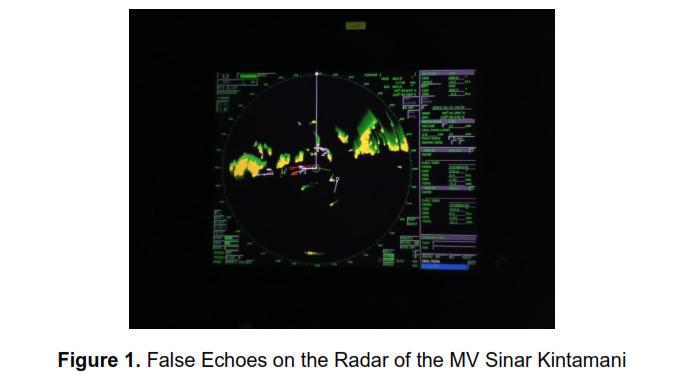
Radar is one of the most important navigational aids on board ships, as it detects targets, coastlines, and weather in conditions in which visual observation is limited and supports collision avoidance in accordance with the COLREGs. Its reliability depends not only on correct operation by the officers of the watch but also on the condition of its components, particularly the magnetron, which has a limited service life. This study analyses the use of radar on board the MV Sinar Kintamani, identifies the factors that made its performance less than optimal, and proposes measures to improve the safety of navigation. A qualitative descriptive design was used, with data collected through observation of radar operation on the bridge, interviews with the Master, Chief Officer, and Second Officer, and review of the radar documentation and service report during the authors’ sea practice, supported by a literature review. The ship is fitted with a JRC JMA-9933-SA S-band radar and a JMA-9923 X-band radar. On 15 November 2023, while the ship was passing through the Selayar Strait, the radar displayed false echoes and failed to show some targets clearly. The service report showed that the magnetrons had accumulated 5,908 and 5,701 transmitting hours, well beyond the optimal service life of about 4,000 hours stated by the manufacturer, and they were replaced on 4 June 2024, after which both radars functioned normally. Other contributing factors were inappropriate display and range settings, irregular performance checks, planned maintenance that was recorded but not carried out, unstable electrical supply, and faulty cable connections. Monitoring of magnetron transmitting hours, planned maintenance in accordance with the manufacturer’s manual, regular performance checks, and training of officers in radar operation and interpretation are recommended.
References
Barton, D. K. (2005). Radar system analysis and modeling. Artech House.
Bole, A., Wall, A., & Norris, A. (2014). Radar and ARPA manual: Radar, AIS and target tracking for marine radar users (3rd ed.). Butterworth-Heinemann.
Brady, M., & Edwards, M. (2010). Developments in marine radar magnetrons. In 2010 International Conference on the Origins and Evolution of the Cavity Magnetron (pp. 58–63). IEEE. https://doi.org/10.1109/CAVMAG.2010.5565565
Chauvin, C., Lardjane, S., Morel, G., Clostermann, J.-P., & Langard, B. (2013). Human and organisational factors in maritime accidents: Analysis of collisions at sea using the HFACS. Accident Analysis & Prevention, 59, 26–37. https://doi.org/10.1016/j.aap.2013.05.006
Endsley, M. R. (1995). Toward a theory of situation awareness in dynamic systems. Human Factors, 37(1), 32–64. https://doi.org/10.1518/001872095779049543
Hetherington, C., Flin, R., & Mearns, K. (2006). Safety in shipping: The human element. Journal of Safety Research, 37(4), 401–411. https://doi.org/10.1016/j.jsr.2006.04.007
International Maritime Organization. (2004). Resolution MSC.192(79): Adoption of the revised performance standards for radar equipment. International Maritime Organization.
International Maritime Organization. (2011). STCW including 2010 Manila amendments: STCW Convention and STCW Code (2011 ed.). International Maritime Organization.
International Maritime Organization. (2018). COLREG: Convention on the International Regulations for Preventing Collisions at Sea, 1972 (2018 ed.). International Maritime Organization.
International Maritime Organization. (2020). SOLAS: Consolidated edition 2020. International Maritime Organization.
Karatuğ, Ç., Arslanoğlu, Y., & Guedes Soares, C. (2023). Review of maintenance strategies for ship machinery systems. Journal of Marine Engineering & Technology, 22(5), 233–247. https://doi.org/10.1080/20464177.2023.2180831
Kasyk, L., Wolnowska, A. E., Pleskacz, K., & Kapuściński, T. (2023). The analysis of social and situational systems as components of human errors resulting in navigational accidents. Applied Sciences, 13(11), Article 6780. https://doi.org/10.3390/app13116780
Kazimierski, W., & Stateczny, A. (2015). Radar and automatic identification system track fusion in an electronic chart display and information system. The Journal of Navigation, 68(6), 1141–1154. https://doi.org/10.1017/S0373463315000405
Kurnia, R., Nurmala, E., Hartati, D. V., Dahlan, H. R., & Balqia, M. F. (2024). Use of radar to enhance shipping safety on the MV. Tanto Salam. ALTAIR: Jurnal Transportasi dan Bahari, 1(2), 1–8. https://doi.org/10.62554/a3r24886
Levanon, N. (2009). New waveform design for magnetron-based marine radar. IET Radar, Sonar & Navigation, 3(5), 530–540. https://doi.org/10.1049/iet-rsn.2009.0007
Ma, F., Chen, Y.-W., Yan, X.-P., Chu, X.-M., & Wang, J. (2016). A novel marine radar targets extraction approach based on sequential images and Bayesian Network. Ocean Engineering, 120, 64–77. https://doi.org/10.1016/j.oceaneng.2016.04.030
Moleong, L. J. (2011). Metodologi penelitian kualitatif. Remaja Rosdakarya.
Rahman, A. (2024). Efforts to improve the safety of navigation from the aspects of equipment and ship safety management. ILTEK: Jurnal Teknologi, 19(1), 28–33. https://doi.org/10.47398/iltek.v19i01.153
Sanchez-Beaskoetxea, J., Basterretxea-Iribar, I., Sotés, I., & Maruri, M. (2021). Human error in marine accidents: Is the crew normally to blame? Maritime Transport Research, 2, Article 100016. https://doi.org/10.1016/j.martra.2021.100016
Skolnik, M. I. (2001). Introduction to radar systems (3rd ed.). McGraw-Hill.
Song, T., Tan, T., & Han, G. (2022). Research on preventive maintenance strategies and systems for in-service ship equipment. Polish Maritime Research, 29(1), 85–96. https://doi.org/10.2478/pomr-2022-0009
Syibli, Y. M., & Nuryaman, D. (2021). The role of navigation equipment in improving the safety of navigation on board. Dinamika Bahari, 2(1), 39–48. https://doi.org/10.46484/db.v2i1.250
Weng, J., Yang, D., Chai, T., & Fu, S. (2019). Investigation of occurrence likelihood of human errors in shipping operations. Ocean Engineering, 182, 28–37. https://doi.org/10.1016/j.oceaneng.2019.04.083
Wright, R. G. (2019). Intelligent autonomous ship navigation using multi-sensor modalities. TransNav, the International Journal on Marine Navigation and Safety of Sea Transportation, 13(3), 503–510. https://doi.org/10.12716/1001.13.03.03